Can a non-resident make a will in the UAE? What DIFC Courts and Abu Dhabi each publish
You can own a flat in Dubai and live in London. DIFC Courts says you do not need to be a UAE resident to register a will, and Abu Dhabi publishes its own rule for non-citizens. Here is what each actually says.
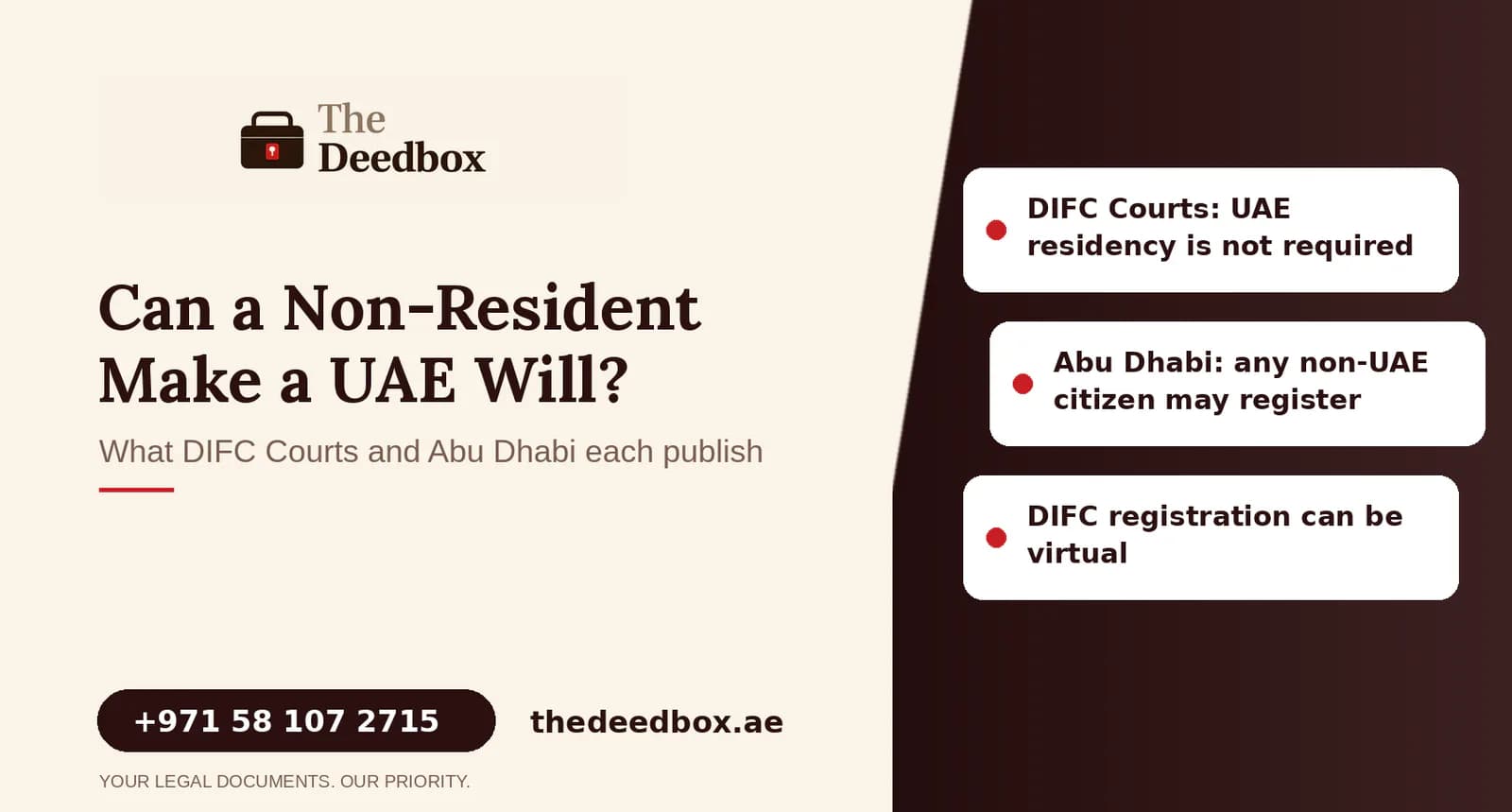
Yes, in many cases. DIFC Courts states that you do not need to be a UAE resident to register a DIFC Courts Will, provided you own assets in the UAE or have minor children living with you here, and you meet its other published conditions. Abu Dhabi's Civil Family Court publishes a separate rule, framed around citizenship rather than residence. The two registries ask different questions, so which one fits depends on your assets, your family and where they are.
What does DIFC Courts publish about non-residents?
The DIFC Courts Wills FAQ answers the question directly: "You do not need to be a resident of the UAE to register a DIFC Courts Will."
It then sets out who may register. You must be "at least 18 years of age", and it states "You are not Muslim and have never been a Muslim". You must also own "assets in the UAE and/or have minor children residing with you in the UAE".
That last condition is the practical test for most non-residents. An owner of a Dubai apartment who lives abroad meets it. So does a parent whose children live in the UAE. Someone with no UAE assets and no children here does not, however attached they are to the country.
Source: DIFC Courts Wills FAQ
Do you have to travel to the UAE to sign?
Not for a DIFC Courts Will. The DIFC Courts FAQ publishes that registration appointments are booked online through the Wills Service portal, and may be held by video conference or in person, signed electronically either way.
Three published conditions matter far more when you are abroad:
- Witnesses. You need "two (2) Witnesses who are not named as a beneficiary or guardian", each at least 18 with valid government-issued photo ID. For a virtual appointment, they may be anywhere in the world.
- Language. The service "presently does not accept translators or POA for Will signing appointments", and testators and witnesses need a basic grasp of English.
- No representative. You cannot send someone in your place with a power of attorney. You attend the appointment yourself, on screen.
Our guide to registering a DIFC will walks through the appointment itself.
What does Abu Dhabi publish?
The Abu Dhabi Judicial Department's Civil Family Court page frames eligibility by citizenship, not residence: "If you are not a UAE citizen, then, regardless of your religion, you may register a Will with Abu Dhabi Civil Wills Office."
Notice what that sentence does and does not say. It opens the Abu Dhabi route to non-citizens of any religion. It does not state a residency condition either way, so we are not going to tell you one exists or does not.
ADJD's own published guidance describes submitting the application through its website and then attending an appointment online before the notary. That guidance is dated 2023, so check the current service before you plan around it.
Source: ADJD Civil Family Court
What about Dubai Courts?
Dubai Courts is the third UAE route for a non-Muslim will, but at the time of writing its service pages were not retrievable, so we could not confirm what it publishes about non-residents. We would rather say that than guess.
DIFC and Abu Dhabi side by side
| DIFC Courts | Abu Dhabi (ADJD Civil Family Court) | |
|---|---|---|
| Residency | "You do not need to be a resident of the UAE" | No residency condition stated |
| Who it is open to | Aged 18+, not Muslim and never Muslim | Non-UAE citizens, "regardless of your religion" |
| Link to the UAE | Assets in the UAE and/or minor children living with you here | Not stated on the page |
| Signing from abroad | Video conference, signed electronically | Online appointment before the notary, per 2023 guidance |
| Witnesses | Two, not beneficiaries or guardians; may be anywhere for a virtual appointment | Not stated on the page |
| Language | Basic English; no translators at the signing | Bilingual template published; signing language not stated |
Registry fees are published by each registry and change without notice, so they are not repeated here. See our guide to what UAE authorities charge for the published figures and the date each was checked, and our comparison of DIFC, Dubai Courts and ADJD wills for the wider differences.
Which route suits a non-resident?
That depends on what you own, where your family lives, and the terms each registry sets, which change over time.
Some practical points to weigh:
- If you are not Muslim and have UAE assets or children here, DIFC Courts publishes the most detail about remote signing, and its conditions are designed for people who may not live in the UAE.
- If you are Muslim, or have ever been, DIFC Courts' published eligibility excludes you, and Abu Dhabi's non-citizen rule is the one to read.
- If you are a couple, mirror wills are two matching wills, one each, and each of you attends your own appointment.
Choosing a route is a practical decision about fit. What a particular will actually achieves over a particular estate is a separate question, and that one is for a lawyer.
What neither registry answers for you
Registering a will in the UAE settles how the registry records it. It does not, on its own, answer:
- Whether a UAE-registered will is recognised by a court in the country where you live.
- How it interacts with a will you have already made elsewhere.
- Whether it reaches assets you hold outside the UAE.
DIFC Courts states that a Full Will "may include assets within the UAE as well as outside of the UAE", but whether a foreign court gives effect to that is decided by that court. If you have assets or a will in another country, take advice there too. If you have no will at all, our guide on what happens without a will in Dubai explains the published starting point.
The Deedbox prepares will documents and coordinates registration with the registry you choose. We are not a law firm, and the registry decides what it will register. You can start with a DIFC Will or an ADJD Will and see the full draft before you pay.
Frequently asked questions
Can I register a DIFC will if I have never lived in the UAE?
DIFC Courts states that you do not need to be a UAE resident. You still need to meet its other published conditions, including owning assets in the UAE or having minor children living with you here.
Can my witnesses be in another country?
For a DIFC Courts virtual appointment, yes. DIFC Courts publishes that witnesses may be anywhere in the world, provided they are adults with valid photo ID and are not named as beneficiaries or guardians.
Can a relative in Dubai sign my will for me?
Not at DIFC Courts. It states that it does not accept translators or a power of attorney at will-signing appointments, so you attend yourself, by video or in person.
Can a Muslim non-resident register a will in the UAE?
DIFC Courts' published eligibility requires that you are not Muslim and have never been Muslim. Abu Dhabi's Civil Family Court states that non-UAE citizens may register a will there regardless of religion. Read each registry's current conditions before choosing.
Does a UAE will cover my property back home?
A DIFC Full Will is described as able to include assets outside the UAE, but whether a court in your home country gives it effect is that court's decision. Take advice where the property is.